Date: April 4, 2026 | Reading time: 5 minutes | Author: Daan Mulder
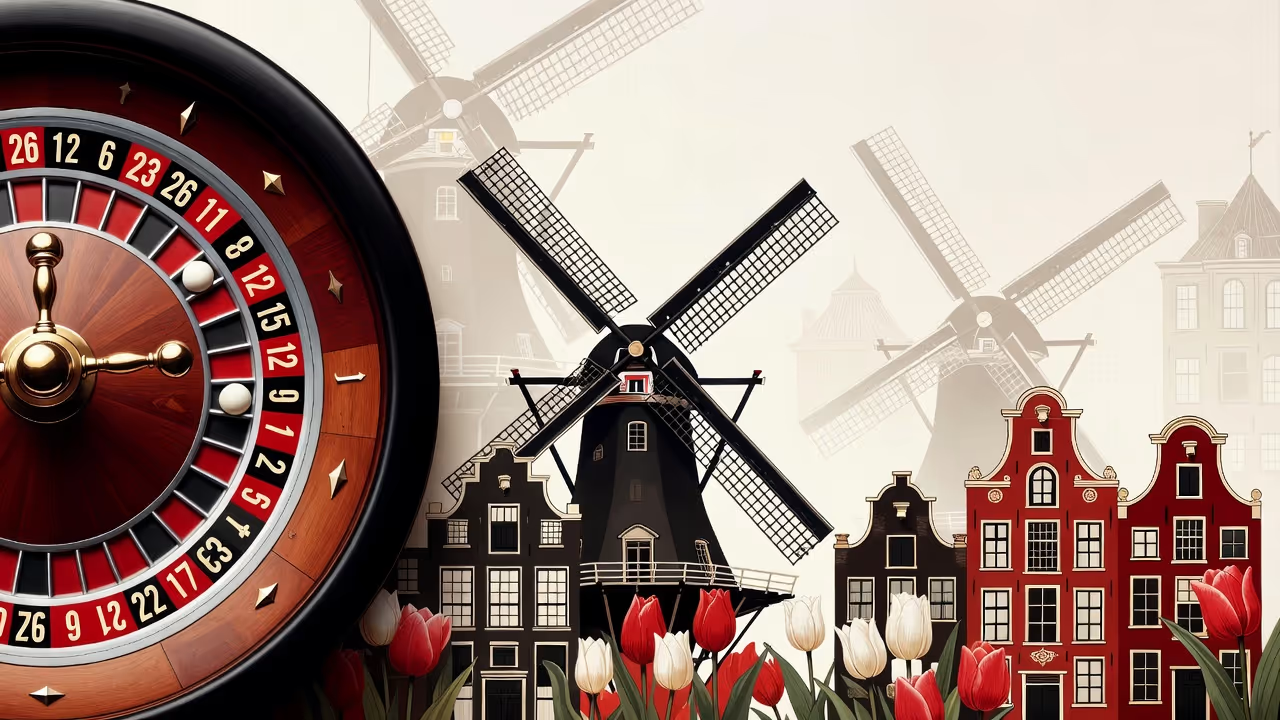
People who look up the history of roulette usually want two things: where the game came from, and whether any of it is useful. This article used to answer that with a Dutch folklore that had no source behind it — Amsterdam as Europe’s roulette capital before Monte Carlo, a fisherman betting his month’s wages on 17 at Scheveningen in 1952. Those stories are gone. What follows is what actually happened.
Where the wheel came from
The story always told begins with Blaise Pascal in the mid-seventeenth century, who is said to have produced a spinning wheel while chasing perpetual motion: it never spun forever, but it survived. Whether it happened quite like that cannot be pinned down — it is the traditional account, and that is how you should read it.
What is firm is that the recognisable game appears in Paris at the end of the eighteenth century. A French description from 1796 records a wheel at the Palais-Royal with two house pockets: a zero and a double zero. Those two pockets are the entire business model. The rest of the wheel pays out as though there were thirty-six numbers; the zeros make sure there are more.
The single decision that shaped modern roulette
In 1843, in the German spa town of Bad Homburg, the brothers François and Louis Blanc did something commercially bold: they removed the double zero. It was not generosity but competition — a wheel with one zero pays players better, so it pulled them away from everyone else.
Do the arithmetic and you see why this is the most important moment in the game’s history. With two zeros there are 38 pockets and a single number pays 35:1 → house edge 2/38 = 5.26%. With one zero there are 37 pockets at the same payout → 1/37 = 2.70%. Same stake, same game, close to half the cost.
François Blanc took that wheel to Monte Carlo from 1863, and single zero became the European standard. In the United States the double zero stayed; some nineteenth-century American wheels even carried a third house pocket marked with an eagle, pushing the edge higher still. The difference between «European» and «American» at a modern table is exactly this piece of inheritance.
The number 666
Roulette is sometimes called «the Devil’s game», and the nickname has a traceable origin: add the numbers 1 to 36 together and you get 666. The sum is correct — try it — and from it grew the legend that Pascal sold his soul. That part is folklore. The arithmetic is the only verifiable thing in it, which is precisely what makes it worth repeating.
Why everyone plays 17
One claim in the old version was half right: 17 really is the most-played number. It simply has nothing to do with the Netherlands. It sits in the middle of the layout, where an outstretched arm naturally lands, and it is the most-bet single number worldwide. Attached to it is the best-known roulette anecdote there is: Sean Connery is said to have hit 17 three times in a row at Monte Carlo in 1963.
The sober half belongs right next to it, or this turns into a strategy. A popular number pays exactly what an unpopular one pays, and the chance for both is 1 in 37. The only thing popularity changes is how many people you share a win with — and at roulette you do not share it.
The Dutch history, without the inventions
The honest version is shorter and more useful than the invented one. The Netherlands has no centuries-old roulette tradition; it has a recent and well-documented one.
Legal casinos exist here only since 1976, when Holland Casino opened its first venue as a state enterprise. That alone dismantles the old «Scheveningen 1952» legend: there was no legal casino for it to happen in. And the licensed online market dates only from 1 October 2021, when the Remote Gambling Act came into force and the Kansspelautoriteit issued the first licences.
That is also why this page no longer makes claims about «full KSA compliance». Whether an operator holds a Dutch licence is recorded in the Kansspelautoriteit’s register and nowhere else — a blog page cannot confirm it for you, and should not try.
What the history actually gives a player
Exactly one thing, and it is the only point here that changes money directly: choose the wheel. French tables with la partage or en prison return half your stake on even-money bets when zero lands, which puts the house edge there at 1.35%. European (one zero) sits at 2.70%. American (two zeros) at 5.26%.
That difference is not a strategy and not a system — it is a choice you make before your first bet, and it is the only decision at the table on which history actually gives you an answer.
Want to put historical insights into practice with smart bonuses? Read our guide on Creative Bonus Hacks for Rizomasolutions Players — modern tactics that perfectly execute the old merchant mindset.
Dutch history also comes alive during festive traditions: discover how celebrations shape modern play in our article Celebration, Emotion and Winning: How Dutch Traditions Enrich Your Casino Experience in 2026 — a warm reminder that the merchant discipline of old still lives on today. And to make the real difference at every table, learn the mental tactics in Psychology at the Blackjack Table: What a Painting Teaches About Decisions — psychology that is worth gold at the roulette table too.
For official information on responsible gambling: UK Gambling Commission.
About the Author